Florida Attorney General Sues Discord Over Age Verification and Content Monitoring
10/20/2026 / By Douglas Harrington

Florida Attorney General (AG) James Uthmeier filed a lawsuit against Discord in Glades County Circuit Court, alleging the chat platform failed to verify users’ ages properly and did not thoroughly scan private messages and other content, according to a copy of the complaint obtained by Reclaim The Net [1].
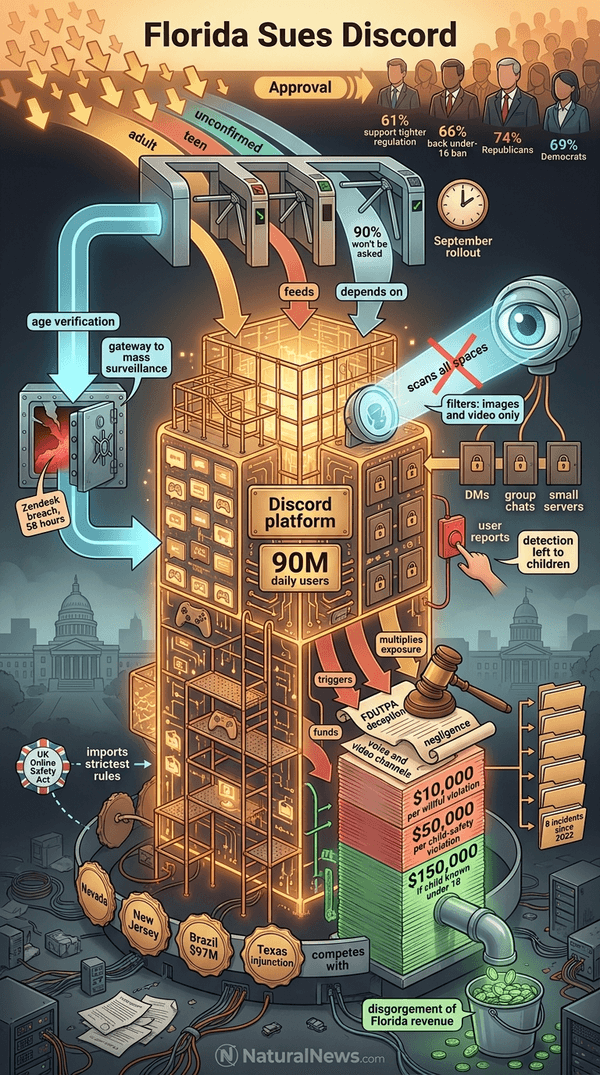
Florida officials said the platform had 90 million active daily users as of 2025, according to its website [2].
In September, Discord rolled out an age verification system that sorts accounts into adult, teen, and unconfirmed categories, but the AG’s office says this is “too little, too late.” Following Discord’s recent announcement, the complaint noted that “late-breaking and insufficient announcement cannot undo the harm already caused in violation of Florida law; nor will it fully remedy the problem going forward” [1].
The state is asking the court to order changes to Discord’s practices, including what the complaint calls “real age verification” [1].
Background on Discord’s Age Verification and Monitoring Policies
Discord’s September system introduced three groups per account: adult, teen, and unconfirmed, and Discord said, “more than 90% of you won’t be asked to confirm your age” [1]. The company said at the time that “we don’t look at your messages, calls, or other content” [1].
According to the complaint, Discord’s own policy states that it monitors “all spaces for high harm content like malware and child sexual abuse material,” but does “not scan all content in smaller spaces such as direct messages (DM), group chats, and small/non-community servers” [1]. The attorney general’s office said the filters the company introduced apply “only to images and videos. They do not scan text messages, voice, or calls” [1].
The state said the company “fails to monitor private spaces on its platform for nefarious activities and instead relies on users to report inappropriate content and conduct” [1].
Privacy advocates have long warned that age verification systems function as gateways to broader surveillance. A separate NaturalNews.com report on the Federal Trade Commission‘s COPPA age verification policy said that collecting biometrics, IDs, and behavioral data under the guise of verifying a child’s age “effectively legalizes mass surveillance of minors” [3].
Legal Claims: Deceptive Practices and Negligence
The lawsuit’s first count alleges a violation of the Florida Deceptive and Unfair Trade Practices Act (FDUTPA) through “deceptively representing that Discord scans for inappropriate and explicit content knowing that it does not scan all spaces on its platform” [1]. A second count alleges negligence based on the same monitoring gap; the filing states [1].
The complaint also claims Discord was deceptive in “representing that children under the age of 13 are not allowed on Discord’s platform while failing to apply age verification measures to stop age falsification,” and it describes operating the platform “without requiring age verification” as unfair and unconscionable [1].
Among the unfair practices the complaint lists is “endangering children by including features like voice and video channels on its platform” [1]. The state also argued that Discord “could easily limit children’s exposure to adults and predators by requiring a user to verify his or her age to increase the level of visibility or activity sharing on the platform” [1].
The lawsuit cites eight incidents since 2022 in which adults sexually exploited minors through the platform, according to CBS News Miami [4].
At the Tampa press conference, Uthmeier said, “Discord told parents not to worry.” He continued: “But what the records and cases show is that Discord has not had real age verification.”
Uthmeier added, “We’re asking the court for real protections, programmatic changes to ensure real age verification” [1].
The legal theory rests on the gap between the company’s public safety messaging and the limits of its actual monitoring, as described in the filing [1].
Remedies Sought by the State
The state also wants the court to impose civil penalties of up to $10,000 per willful violation of FDUTPA and up to $50,000 for each violation of the state’s law on children in online spaces, the complaint states [1].
Discord should also be required to pay up to $150,000 for each violation of the state’s online child safety law if the company knew the child was under 18, according to the filing [1]. The complaint additionally seeks disgorgement of all money and property that Discord has taken from Florida consumers [1].
The penalty structure mirrors the state’s broader enforcement posture toward technology platforms. Florida previously gave tech companies a deadline of April 8, 2026, to build identity verification systems into their platforms or face lawsuits, under a law that bans anyone under 14 from social media and requires parental consent for 14- and 15-year-olds [5].
Uthmeier filed a 66-page complaint in St. Lucie County Circuit Court accusing TikTok of age verification failures [6].
Broader Regulatory and Industry Context
Florida’s suit is one of several state actions against Discord. Nevada, Indiana, and New Jersey have also sued Discord, and Brazil is seeking $97 million from the company and wants it to expand age verification [1].
In August 2026, a Collin County, Texas judge signed an agreed temporary injunction requiring Discord to extend the age-verification system it built for the United Kingdom’s Online Safety Act to every user in Texas within 90 days, according to a copy of the order obtained by Reclaim The Net [7].
The push for expanded verification has a documented security cost. The incident began on September 20, 2025, when attackers infiltrated a Zendesk-based platform for 58 hours, the report stated [8].
Public opinion polling shows broad support for age verification laws even as privacy concerns persist. A bipartisan Reuters/Ipsos poll found 61% of Americans support tighter regulation of social media, with 66% backing laws to keep children under 16 off platforms, and 74% of Republicans and 69% of Democrats in favor of age verification, according to NaturalNews.com [9]. Critics argue the measures create centralized identity infrastructure.
A July 2026 Brownstone Institute essay by Josh Stylman described digital ID as foundational to government control over online access [10].
Case Status and Next Steps
The complaint represents the latest front in a pattern described in the filing in which companies implement age checks under regulatory pressure and are then asked to do more [1]. In this case, the additional demand would extend scanning beyond images and videos to text messages, voice, and calls, a step that would end private conversation on the platform, according to the analysis of the filing [1].
References
- Florida Attorney General Sues Discord Over Lack of ID Checks Content Monitoring. https://reclaimthenet.org/florida-sues-discord-age-verification-content-monitoring
- Florida’s attorney general sues Discord, says platform exposes kids to predators. https://www.miamiherald.com/news/politics-government/state-politics/article317639306.html
- FTCs COPPA age verification loophole A Trojan horse for mass data harvesting of children – NaturalNews.com, March 07, 2026.
- Florida attorney general sues Discord, alleging platform fails to protect minors from predators. https://www.cbsnews.com/miami/news/florida-attorney-general-sues-discord-minors-sexual-predators/
- Florida Gives Tech Platforms Deadline for Age ID Checks. https://reclaimthenet.org/florida-gives-tech-platforms-deadline-for-age-id-checks
- Florida Sues TikTok Over Age Verification Failures as Digital ID Mandate Takes Effect. https://reclaimthenet.org/florida-sues-tiktok-age-verification-law-online-id-checks
- Texas Court Orders Discord to Extend UK Style Age Verification to State Users – NaturalNews.com, August 01, 2026.
- Discord breach exposes 70000 government IDs through age verification vendor – NaturalNews.com, October 10, 2025.
- Two thirds of Americans back age verification laws for teens, but fixes give Big Tech sensitive personal data – NaturalNews.com, August 10, 2026.
- The Authentication Layer. https://brownstone.org/articles/the-authentication-layer/
Explainer Infographic
Submit a correction >>
Tagged Under:
age checks, age verification, banned, Big Tech, child online protection, child online safety, child predators, content monitoring, digital ID, Discord, Florida, ID checks, Internet safety, James Uthmeier, lawsuit, obey, Orwellian, privacy watch, Social media, social media bans, surveillance, tech giants, technocrats, user safety, watched
This article may contain statements that reflect the opinion of the author
RECENT NEWS & ARTICLES