A stark red line: Moscow threatens to target western troops in Ukraine
02/05/2026 / By Willow Tohi
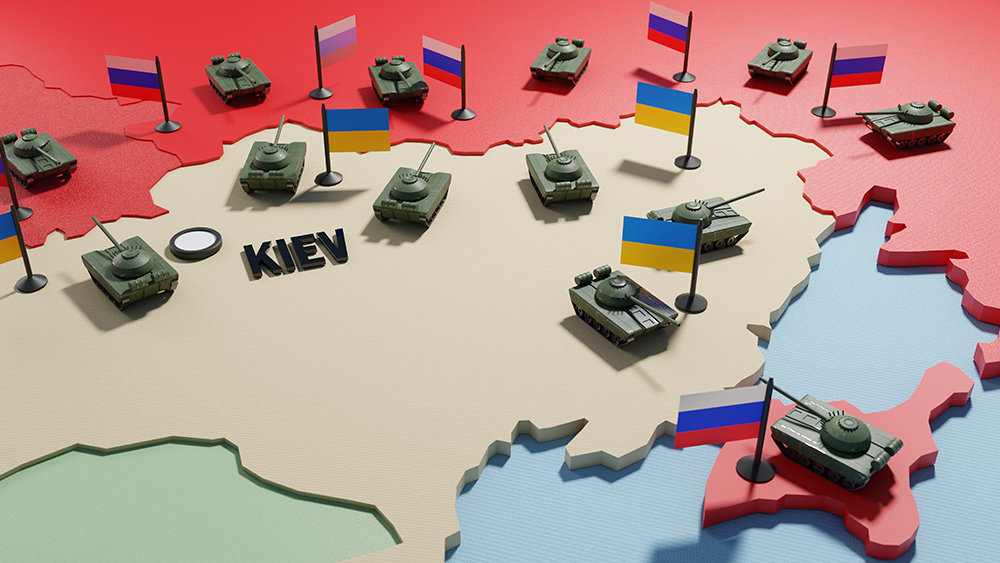
- Russia warns any Western troops deployed to Ukraine, even post-ceasefire, will be considered “legitimate combat targets.”
- The warning follows a UK-France-led declaration to form a multinational force for Ukraine after a potential peace deal.
- Moscow condemns the plan as a “veritable axis of war” and direct foreign intervention.
- Ukraine and its allies argue such security guarantees are necessary to deter future Russian aggression.
- The U.S. has ruled out sending its own ground troops but offers political support for the European-led initiative.
In a dramatic escalation of rhetoric, Russia has declared that any deployment of Western military forces to Ukraine—even under a future ceasefire agreement—would make those troops “legitimate combat targets” for the Russian armed forces. The stark warning, issued by Russian Foreign Ministry spokeswoman Maria Zakharova on January 8, directly responds to newly announced plans by the United Kingdom and France to lead a multinational force intended to support Ukraine after a peace deal. This confrontation sets a perilous new condition for any potential settlement, framing the prospect of Western boots on the ground not as a stabilizing guarantee but as an act of war against Russia itself.
The coalition’s contingency plan
The immediate catalyst for Moscow’s warning was a meeting in Paris of the so-called “Coalition of the Willing,” a group of Ukraine’s staunchest Western backers. Following the summit, British Prime Minister Keir Starmer and French President Emmanuel Macron formalized a declaration of intent to create a framework for deploying forces to Ukraine after a ceasefire. The proposed multinational force, potentially involving thousands of French troops positioned away from front lines, aims to help secure Ukraine’s borders, rebuild its military and provide a long-term deterrent against future Russian attacks. U.S. Special Envoy Steve Witkoff affirmed American political support for such security guarantees, though President Donald Trump has explicitly ruled out sending U.S. ground troops.
Moscow’s unyielding interpretation
From the Kremlin’s perspective, these plans represent a fundamental and unacceptable threat. Russian statements consistently frame the conflict as a defensive action against NATO encroachment, and any permanent Western military presence in Ukraine is viewed as the realization of its worst-case scenario. Zakharova condemned the UK-France initiative as a “veritable axis of war,” accusing the West of seeking not peace but the further militarization of Ukraine. The Russian Foreign Ministry emphasized that its position has been stated “more than once at the highest level,” signaling that this is a settled and non-negotiable red line rather than a mere bargaining position.
The historical precedent of security guarantees
The debate over post-war security arrangements echoes Cold War-era divisions in Europe. Ukraine and its allies argue that without concrete, enforceable guarantees—which could include a foreign military presence—any peace agreement would be fragile, leaving the country vulnerable to a renewed Russian offensive years later. This logic draws from historical instances where the presence of allied forces, such as U.S. troops in South Korea following the 1953 armistice, has provided a lasting deterrent. Russia, however, invokes its own historical narrative of Western betrayal and expansionism, comparing the proposed force to hostile alliances at its borders and vowing a symmetrical response.
The escalatory risk and strategic calculus
The explicit threat to target foreign troops marks a significant intensification in Russia’s warnings and raises the stakes for Western policymakers. Key implications include:
- Effectively vetoing a major component of Ukraine’s desired security architecture.
- Creating a severe deterrent against NATO countries considering direct deployment.
- Setting conditions that could rapidly escalate any localized clash into a direct Russia-NATO conflict.
This move appears calculated to test Western resolve and sow division among allies by presenting them with a choice between offering Ukraine robust security assurances and avoiding a direct military confrontation with a nuclear-armed state.
A dangerous impasse for diplomacy
The Russian warning creates a formidable obstacle for ongoing peace efforts. Ukrainian President Volodymyr Zelenskyy has stated that security guarantee documents are nearly ready for finalization with the U.S., but Moscow’s latest statement suggests that any deal including a Western troop presence would be deemed a provocation. The U.S. has indicated it will engage with Russia on the proposals, but the gap between the sides appears vast. The West insists on guarantees to uphold Ukraine’s sovereignty, while Russia demands a neutral Ukraine free of foreign military influence—conditions that are mutually exclusive under the current frameworks.
Navigating the brink of a wider war
As diplomatic maneuvering continues, the world is confronted with a stark and dangerous standoff. Russia has drawn its red line in the starkest possible terms, threatening military action against NATO members if they cross it. The Western coalition, meanwhile, is grappling with how to fulfill its commitments to Ukrainian security without triggering the very catastrophe it seeks to prevent. This clash over post-war arrangements may prove as consequential as the battlefield conflict itself, determining not only Ukraine’s future but the stability of European security for decades to come. The path to peace now navigates a narrow ledge, where the mechanisms intended to prevent future war risk igniting a broader one today.
Sources for this article include:
Submit a correction >>
Tagged Under:
act of war, big government, collapse, conspiracy, dangerous, globalism, military tech, Moscow, national security, NATO, risk, Russia, Ukraine, weapons tech, WWIII
This article may contain statements that reflect the opinion of the author
RECENT NEWS & ARTICLES